Alex is Sprintlaw’s co-founder and principal lawyer. Alex previously worked at a top-tier firm as a lawyer specialising in technology and media contracts, and founded a digital agency which he sold in 2015.
Contents
- When is food actually PPDS?
- Why online orders and collection can change the answer
- Three classifications founders should keep separate
- What has to be on the pack for physical PPDS sales?
- What information is needed for distance sales?
- Practical examples for mixed counter and click and collect setups
- Operational steps that make this easier to manage
FAQ
- Does bold text have to be used for allergens?
- Is every click and collect order exempt from full pack labelling?
- What if my staff pack the food in the morning expecting orders later that day?
- What if I buy sealed products from another small producer and resell them?
- Do website terms replace allergen compliance?
- Key Takeaways
If your business sells prepared food through a counter, a website, phone orders or click and collect, the key legal question is not simply whether the item is wrapped. The real question is who packed it, where it was packed, and whether it was packed before the customer order or after it. That classification affects what information must appear on the pack and what information can instead be given before purchase and at delivery.
For businesses in England and Wales, food that is prepacked for direct sale, often shortened to PPDS, has special labelling rules for physical sales. But those rules do not apply in exactly the same way to food sold only by distance means such as internet or telephone orders, and they do not turn every click and collect product into the same answer. A sandwich packed for the counter before anyone orders it is different from a sandwich wrapped after an online order comes in.
When is food actually PPDS?
In England and Wales, food is generally treated as PPDS where the same food business packs it before it is offered for sale and then sells it to the final consumer from the same premises, the same site, or in some cases from a moveable or temporary premises used by that same business.
There are two practical points hidden inside that definition.
First, the food must be packed before it is offered for sale. If the packaging happens only after the order is taken, it is not PPDS.
Second, the food must be packed by the same business that sells it. If one business packs it and another business sells it, that is not PPDS for these purposes, even if the product is sitting in a small fridge beside the till.
The packaging also needs to enclose the food so the contents cannot be altered without opening or changing the packaging. A fully sealed pack is the obvious example, but a partly enclosed item can still count if the contents cannot be changed without opening or changing the pack.
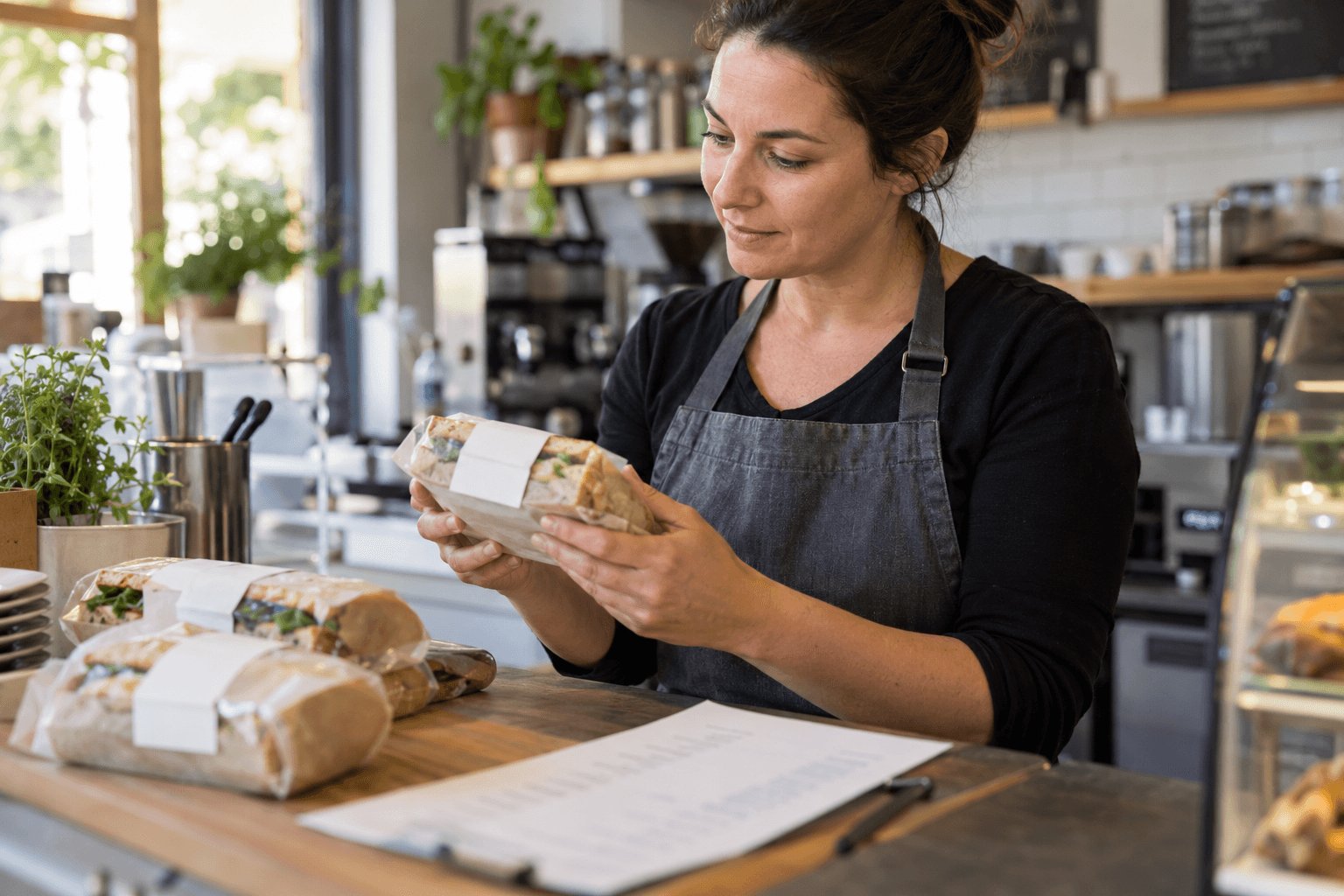
This is why some café sandwiches are PPDS and some are not. A row of sandwiches made in the morning, packed and placed in a display chiller for later sale may be PPDS. A sandwich assembled when a customer orders and only then wrapped for takeaway is not.
Why online orders and collection can change the answer
Business owners often assume click and collect has one fixed rule. It does not. The answer depends on what happens in practice.
If you pack food in advance, place it into stock for sale, and a customer later chooses that item online for collection, the item may still be PPDS because it was already packed before being offered for sale.
If you receive an online order first and then make or pack the item to fulfil that order, the food is not PPDS. That is because it was not packed before being offered for sale.
Distance selling adds another layer. For food sold through distance means such as telephone or internet ordering, allergen information must still be available free of charge before the customer buys and also be available at delivery. But the special Regulation 5A duty to provide a full ingredients list on the package does not apply where PPDS food is sold online, by telephone or by mail order only.
That point is narrow and should be handled carefully. It does not mean distance selling removes all food information duties. It does not mean online shop terms and conditions solve the issue by themselves. And it does not mean ordinary prepacked foods fall outside normal rules. It simply means the PPDS specific full ingredients list duty is not the rule that governs food sold by distance means only.
Three classifications founders should keep separate
It helps to separate three categories.
- PPDS food: packed by your business before sale and sold by your business from the same premises or site, or from qualifying moveable or temporary premises.
- Food packed after the order: not PPDS, even if wrapped or boxed before handover.
- Prepacked food supplied by another business: prepacked, but not PPDS for your business if another operator packed it and you sell it.
Those distinctions matter because businesses often operate more than one model at once. A deli might stock its own prepacked salads for walk in customers, make baguettes after online orders arrive, and also resell cakes packaged by an outside bakery. Those are not the same legal category.
Where your setup is mixed or unusual, treat classification as a product by channel exercise, not a whole business label.
What has to be on the pack for physical PPDS sales?
Where food is PPDS and is offered for sale otherwise than by distance communication, the package or a label attached to it must include:
- the name of the food
- a full ingredients list
- allergenic ingredients emphasised every time they appear in the ingredients list
Emphasis is required for allergens, but bold text is only one permitted method. Capitals, underlining or contrasting colour may also be used if the allergen stands out clearly.
For a small business, the operational challenge is usually the ingredients list rather than the food name. If your recipes change, or you switch a bought in ingredient for another version with a different allergen profile, your label can become inaccurate very quickly.
That is why businesses selling physical PPDS items usually need a reliable recipe record, an approved label format and a change control process. Without that, the legal wording on paper can drift away from what is actually being packed on site.
Take a simple pasta pot sold from a fridge in your café. If it is packed in advance on site and sold from that site, you would normally need the product name, a full ingredients list and emphasised allergens on the pack. If your pesto changes from one supplier to another and the new version contains a different nut ingredient, your labelling needs to keep up.
What information is needed for distance sales?
For food sold through internet, telephone or similar distance means, mandatory allergen information must be available to the customer before they buy, free of charge, and it must also be available at the moment of delivery.
That usually means thinking about two stages.
Before purchase, the customer needs a clear way to get allergen information while deciding whether to place the order. Depending on the business model, that might be presented in the online ordering flow, by a clearly organised menu entry, or through another process that gives the information before checkout.
At delivery, the information also needs to be available when the food is handed over. For collection businesses, that handover point matters just as much as home delivery.
The practical risk is treating collection as if it were automatically the same as a counter sale or automatically the same as a website only sale. Neither assumption is safe. Ask what the customer is buying, how the item was packed, and when the relevant information is actually given.
If you run an online only ordering system for boxed lunches and you pack each lunch after receiving the order, that is not PPDS. If you pack identical boxed lunches in advance and customers order those packs online for later collection, the product may be PPDS in substance, but the sale channel still engages the distance selling allergen rules. That is why the process mapping matters.
Practical examples for mixed counter and click and collect setups
These examples are hypothetical, but they show why timing and operator identity matter.
Example 1: Packed counter stock
A café makes wraps at 8 am, labels them and places them in a chilled display. Customers can buy them in person during the day. That is likely to be PPDS. For physical sale, each pack should carry the food name, full ingredients list and emphasised allergens.
Example 2: Online reservation of existing stock
The same café allows customers to reserve one of those already packed wraps online for collection at lunchtime. The item was packed before the order, so the product may still fall within PPDS principles. But because the order is placed by distance means, the café still needs allergen information before purchase and at handover, and should not assume the answer is identical to a pure walk in sale.
Example 3: Packed after order
A customer orders a chicken baguette online at 11 am. Staff prepare it at 11.20 am, wrap it and place it behind the counter for collection. That item is not PPDS because it was packed after the order.
Example 4: Another business packed it
A farm shop sells brownies supplied in sealed packaging by a local baker. Even if the farm shop puts those brownies near the till and sells them direct to consumers, the farm shop did not pack them. That is prepacked food supplied by another business, not PPDS for the farm shop.
Example 5: Same operator, same site, multiple outlets
A food operator prepares boxed salads in one unit of a station complex and sells them in another unit within that same complex operated by the same business. That may still be PPDS if the same operator packed them on the same site before sale.
If your business sits between examples, or uses concessions, shared kitchens or multiple entities, get specialist food compliance advice before settling your labels or online ordering flow.
Operational steps that make this easier to manage
Most labelling problems start in operations rather than in legal drafting. A few practical systems can make a big difference.
- Keep a product and channel record. List each item you sell, where it is packed, when it is packed, who packs it, and whether it is sold over the counter, online, by phone, by collection or by delivery.
- Record recipes and bought in components. Keep supplier specifications for ingredients, sauces, toppings and fillings so your team knows the correct allergen position.
- Use an ingredient change notification process. If a supplier changes a formulation, or a site substitutes ingredients, that change should trigger a label and menu review.
- Separate stock packed in advance from made to order items. This helps avoid staff using the wrong label or the wrong sales script.
- Check the customer journey. Make sure allergen information is genuinely available before purchase for distance sales and available again at handover or delivery.
These are sensible business processes, not statutory templates. The point is to reduce the gap between the product your customer receives and the information your business provides.
FAQ
Does bold text have to be used for allergens?
No. Allergens must be emphasised wherever they appear in the ingredients list, but bold is only one acceptable method. Other forms of clear emphasis may also be used.
Is every click and collect order exempt from full pack labelling?
No. You should not assume that. The answer depends on whether the item is PPDS, whether it was packed before or after the order, and how the sale is made. Distance sales still require allergen information before purchase and at handover.
What if my staff pack the food in the morning expecting orders later that day?
Food packed in anticipation of sale before the order is taken can fall within PPDS. That is different from food packed only after a customer places an order.
What if I buy sealed products from another small producer and resell them?
If another business packed the food and your business sells it, that is not PPDS for your business. Do not treat supplied products and your own packed products as one category.
Do website terms replace allergen compliance?
No. Commercial website terms can help set out ordering rules and customer processes, but they are not a substitute for meeting food information requirements.
Key Takeaways
- For England and Wales, classification turns on who packed the food, where it was packed, and whether it was packed before or after the order.
- PPDS generally means the same business packed the item before sale and sells it from the same premises or site, or qualifying moveable or temporary premises.
- Food packed after a customer orders is not PPDS, even if it is wrapped before collection or delivery.
- Food packed by one business and sold by another is prepacked, not PPDS for the seller.
- For physical PPDS sales, the pack needs the food name, full ingredients list and emphasised allergens.
- For distance sales, allergen information must be available free before purchase and also at delivery or handover, but the PPDS specific full ingredients list duty does not apply to PPDS sold online, by telephone or by mail order only.
- Mixed counter, online and collection models should be reviewed product by product and channel by channel.
If you need help reviewing your food labelling setup, website and ordering terms, supplier and ingredient change processes, or internal compliance records for mixed counter and online sales, Sprintlaw's legal team can help. Call 08081347754 or email team@sprintlaw.co.uk.
Drafted by Taylor, Sprintlaw's AI, and overseen by Alex Solo. How we write

Alex SoloCo-Founder